IIT Tirupati logo SEVA Lab logo SEVA Lab

CV Test-Bed Building in Progress

2D plan

Test-Bed Top View

Open PDF
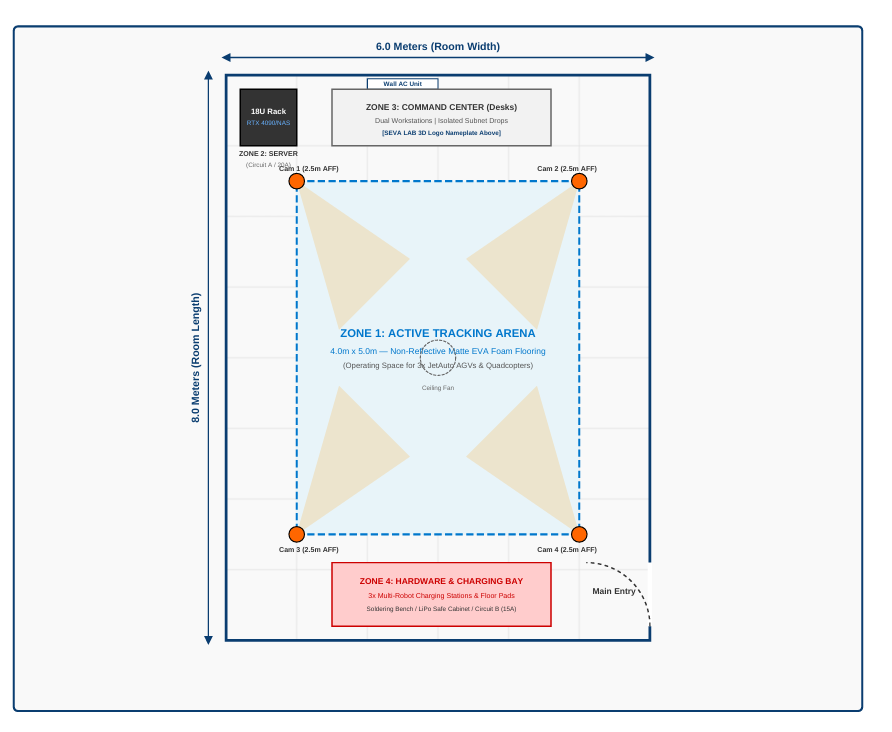
Top-view plan of the SEVA Lab test-bed showing the active tracking arena, server rack, command center, hardware bay, cameras, and room dimensions.
Execution plan showing the 6 m x 8 m room and its four functional zones.

Interactive model

3D Test-Bed Viewer

Loading 3D model...

Test-Bed Specifications

Detailed zoning, infrastructure, motion-capture, perception, and electrical requirements.

Detailed Zone & Furnishing Specifications

Zone Designation Physical Bounds Furnishing & Hardware Mounted Structural, Civil & Environmental Requirements
Zone 1: Active Arena 4.0 m x 5.0 m (20.0 sq. m) 3x NVIDIA JetAuto AGVs, 2x quadcopters, 4x HTC Vive Base Stations 2.0 20 mm interlocking matte black/grey EVA foam puzzle mats; no high-gloss reflective surfaces; 4x wall camera brackets mounted at 2.5 m AFF.
Zone 2: Server Rack 0.8 m x 1.0 m (NW corner) 18U rolling rack, RTX 4090 workstation, Synology NAS, ASUS router, PoE+ switch Open/enclosed heavy-duty rack, floor cable raceway, and placement directly in the AC airflow path for heat dissipation.
Zone 3: Command Center 3.1 m x 1.0 m (North wall) 2x heavy-duty office desks, 4x 4K monitors, 2x PhD laptops Dual workstation layout; 1.0 m x 0.5 m SEVA Lab 3D logo nameplate centered at 1.8 m AFF; dual RJ45 wall drops terminating at Zone 2.
Zone 4: Hardware Bay 3.1 m x 1.0 m (South wall) 3x wall charging stations with floor pads, soldering bench, LiPo safe cabinet, drones Static-dissipative workbench matting, flame-resistant LiPo storage, local soldering fume extractor, and 3 trailing cable runs to robot pads.

Wall Painting, Branding & Environmental Controls

  • Wall painting: Ultra-flat, low-VOC white walls with a continuous 0.15 m SEVA Lab Blue (#0B3D70) accent band from 0.05 m to 0.20 m AFF.
  • Lab signage: A 1.0 m x 0.5 m white backing plate with the 3D SEVA Lab logo, centered above the Command Center at 1.8 m AFF.
  • HVAC: Minimum 1.5-ton / 1.5 kW wall-mounted split AC at 2.5 m AFF, maintaining 20°C-22°C under approximately 1000 W peak GPU load.
  • Ceiling ventilation: One industrial three-blade fan at room center, 2.8 m AFF, providing gentle circulation without disturbing quadcopter flights.
  • Window control: 100% optical and IR blackout roller blinds to protect RealSense and motion-capture sensors from direct sunlight.
  • Safety: One Class ABC/D fire extinguisher near the entrance and dual 1.5 m wall-mounted shelves for spare parts.

Complete Hardware Manifest & Technical Specifications

Computing, Storage & Networking Infrastructure

1. Central GPU Compute Server (RTX 4090 Workstation)

GPU ArchitectureNVIDIA GeForce RTX 4090 Founders Edition (Ada Lovelace), 24 GB GDDR6X VRAM, 384-bit bus, 1,008 GB/s bandwidth
Compute Cores16,384 CUDA cores, 512 fourth-generation Tensor cores, 128 third-generation RT cores
CPU & MemoryIntel Core i9-14900K (24 cores / 32 threads, up to 6.0 GHz), 128 GB DDR5 5600 MHz ECC RAM
Storage Subsystem2 TB NVMe PCIe 4.0 OS drive + 4 TB NVMe scratch cache for point clouds
Network InterfaceDual 10GbE / 2.5GbE RJ45 ports onboard
Software RoleROS 2 Fast DDS Discovery Server, NVIDIA Isaac Sim digital twin, global 3D SLAM map merging, and deep-learning model training

2. Synology DiskStation DS925+ NAS (Central Storage)

Enclosure & Disks4-bay enclosure with 4x 10 TB Seagate IronWolf 7200 RPM SATA HDDs in RAID 5, providing approximately 30 TB usable storage
Cache & NetworkDual M.2 NVMe SSD cache slots with 2x 1 TB read/write cache; dual 2.5GbE RJ45 ports with LACP
ThroughputUp to 522 MB/s sequential read and 565 MB/s sequential write
Software RoleContinuous NFS mount at /volume1/rosbags_seva for rosbag2 files, video datasets, and model checkpoints

3. ASUS ROG Rapture GT-AX6000 Wi-Fi 6 Router

Processor & Specs2.0 GHz quad-core 64-bit CPU; dual-band Wi-Fi 6 (802.11ax) up to 6000 Mbps aggregate speed
Wired PortsDual 2.5G ports (1x WAN, 1x LAN) + 4x 1G LAN ports
QoS & SubnetDedicated QoS prioritization for ROS 2 DDS UDP traffic on isolated subnet 192.168.50.0/24

Ground Truth & Motion Capture System

HTC Vive Base Station 2.0 & Tracker 3.0 System

Base Stations (x4)SteamVR Tracking 2.0, 150° x 110° FOV, sub-millimeter positional accuracy at 240 Hz; corner-mounted at 2.5 m AFF
Trackers (x3)HTC Vive Tracker 3.0 mounted to JetAuto robots through a 1/4-inch UNC camera thread; 7.5-hour battery life; integrated IMU
VRPN StreamingDedicated Windows master PC running SteamVR and a VRPN server, publishing geometry_msgs/PoseStamped to ROS 2

Perception & Vision Sensors

1. Intel RealSense D455 Stereo Depth Camera

Optics & ShutterDual RGB-D, 95 mm baseline, and global shutter on RGB and depth sensors to reduce motion-blur distortion
Resolution & FOV1280 x 720 at 90 FPS; depth FOV 95° x 65°; operating range 0.6 m-6.0 m with less than 2% depth error at 4 m
IMUIntegrated Bosch BMI085 6DoF IMU for tightly coupled visual-inertial odometry

2. Luxonis OAK-D Pro Auto-Focus (Spatial AI Camera)

Onboard ComputeIntel Movidius Myriad X VPU with 4 TOPS neural-network inference
IlluminationActive stereo with IR dot projector and flood LED for textureless-surface depth perception in darkness
RoleRuns YOLO / MobileNet detection on-camera and outputs 3D spatial bounding-box coordinates over ROS 2

Livox Mid-360 3D Hybrid Solid-State LiDAR

FOV & Point Rate360° horizontal x 59° vertical non-repetitive scanning pattern; up to 200,000 points per second
Range & Communication40 m at 10% reflectivity, 70 m at 80% reflectivity; 100BASE-TX Ethernet publishing ROS 2 sensor_msgs/PointCloud2

Electrical Infrastructure & Dual-Circuit Isolation

Power is separated into two physically independent breaker circuits to protect GPU server operations from high-current bench short circuits.

Critical electrical mandate: Circuit A is reserved only for compute and networking equipment in Zone 2. Power tools, soldering irons, and battery chargers must not be connected to Circuit A. Battery charging must take place in Zone 4 on Circuit B using flame-resistant containment bags or metal ammunition cans.